SAFETY TRAINING BRIEF
BETTER COMMUNICATION. SAFER WORKPLACE
Hazard Overview
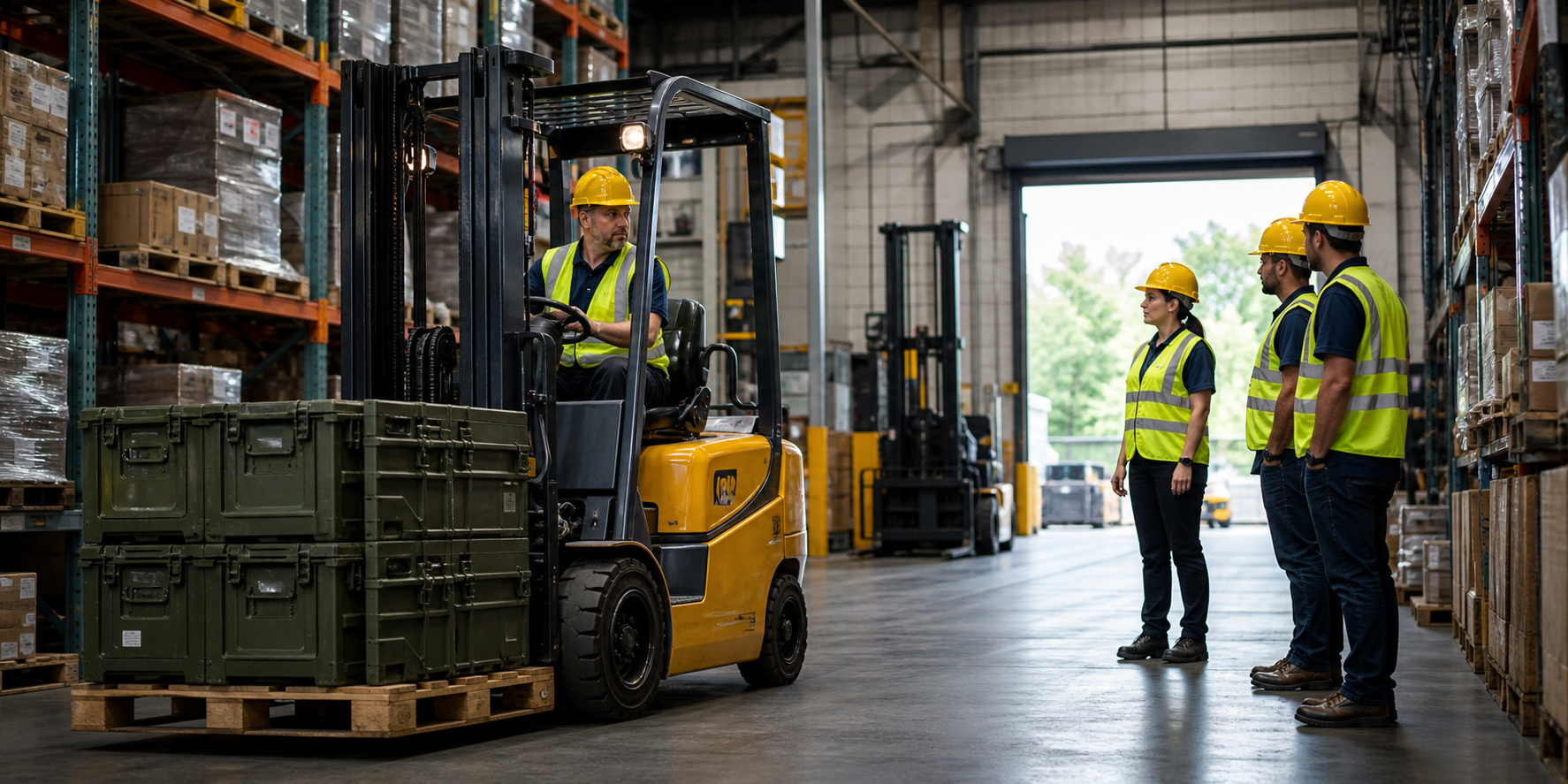
Forklifts present a serious hazard to pedestrians and other workers because of their size, weight and limited visibility. A forklift can weigh several tons and may be carrying loads that impact the operator’s view. Forklifts often have blind spots to the front, sides and rear, making it difficult for operators to see workers on foot. Unlike passenger vehicles, forklifts are not designed for sudden stops or sharp turns, which increases the risk of striking a pedestrian who steps into a travel path.
Pedestrians are especially vulnerable in areas where forklift traffic and foot traffic share the same space, such as warehouses, production floors, and loading docks. Serious injuries can occur when workers are struck by a moving forklift, caught between a forklift and a fixed object, or crushed by a falling or shifting load. The risk increases at intersections, blind corners, dock edges and doorways, as well as when workers walk too close to raised forks or loads. Distractions, poor lighting and obstructed walkways further increase the likelihood of an incident.
Many forklift-related pedestrian incidents happen when workers assume an operator sees them or try to move quickly through forklift areas. Running, using mobile devices or rushing to save time reduces awareness and reaction time for both pedestrians and operators.
Safe Work Procedures
The following procedures can keep workers safe when working around forklifts:
- Wear required personal protective equipment, including high-visibility vests.
- Stay alert and assume forklifts may be operating at all times.
- Use designated pedestrian walkways, aisles and crossings.
- Be aware that forklifts can’t stop suddenly. Maintain a minimum safe distance from moving forklifts, forks and loads.
- Stop at aisle intersections and look both ways before proceeding.
- Make clear eye contact with the forklift operator before crossing in front of or near the truck.
- Wait for the operator to acknowledge you and bring the forklift to a complete stop before crossing in front of or near the truck. Proceed only when it is safe and consistent with site traffic rules.
- Stay well clear of turning forklifts, as rear ends can swing wide.
- Stand clear when forklifts are lifting, lowering, stacking or unstacking loads.
- Allow forklifts extra space on ramps and inclines.
- Pay attention to forklift warning devices, including horns, backup alarms, lights and strobes.
- Be especially cautious near blind corners, doorways, trailers, racks and dock areas.
- Use mirrors and posted signs to anticipate forklift traffic.
- Stay in well-lit areas and report lighting issues immediately.
- Follow all site traffic flow rules, including one-way aisles and designated stop points.
- Report near-misses or close calls involving forklifts to supervision.
- Keep walkways free of debris, pallets and obstructions that force pedestrians into forklift paths.
- Stop and wait until the forklift passes if unsure whether it is safe to proceed.
What Not to Do
Remind workers of what not to do around forklifts, including the following:
- Do not assume a forklift operator can see you.
- Do not run up to or suddenly approach a forklift, even if it appears stopped or unattended.
- Do not walk behind or beside a moving forklift.
- Do not cross directly in front of a moving forklift, even if it appears to be slowing.
- Do not use cellphones or other unapproved devices in the forklift operating area.
- Do not stand or walk in forklift travel lanes unless crossing at approved locations.
- Do not linger in loading zones, dock edges or trailer entrances.
- Never walk under raised forks or suspended loads for any reason.
- Never stand between a forklift and a fixed object, such as a wall or rack.
- Do not touch forks, chains, mast components or loads.
- Do not approach forklifts that are actively lifting, lowering or tilting loads.
- Do not enter forklift-only areas unless authorized and it is safe to do so.
- Do not cut through work areas to save time.
- Do not ignore horns, alarms, flashing lights or verbal warnings.
- Never hitch a ride on a forklift or ride on the forks.
- Never engage in horseplay or run in the workplace.
Take Action
Complete one or more of the following activities with workers to reinforce the safety messaging. The following activities are sample activities that can be performed.
Group Discussion: What are some “do’s” and “don’ts” for pedestrians when working near forklifts?
Group Discussion: What role do pedestrians play in preventing incidents?
Review: Go over facility forklift traffic rules and pedestrian policies.
Review: Explain emergency procedures that team members must follow in the event of a pedestrian injury caused by a forklift.
Review: Discuss forklift warning devices, such as horns, alarms and lights, and what they mean.
Demonstrate: Using a secured, non-operating forklift in a controlled training area, demonstrate how forklift blind spots work by identifying positions where an operator may not be able to see a pedestrian. Keep the truck and load stationary and have a qualified trainer supervise the activity.
Applicable Standards/Regulations/Policies
The following list provides notable applicable standards, regulations and guidance. Please note that additional federal and state rules may apply, as well as company safety policies.
- OSHA 29 CFR 1910.178 (Powered Industrial Trucks)
- ANSI/ITSDF B56.1 (Safety Standard for Low Lift and High Lift Trucks)
COMPLIANCE | RISK PREVENTION | RISK FINANCE | COMMUNICATION
THE HOLT GROUP LLC | www.theholtgroupllc.com
This Safety Matters document is not intended to be exhaustive, nor should any discussion or opinion be construed as legal advice. Readers should contact legal counsel for appropriate advice. © Zywave, Inc., The Holt Group LLC All rights reserved. All images are from Google Images and Story Blocks. Revised 2026
.png?width=626&height=160&name=image%20(6).png)