THE HOLT GROUP | HERE TO HELP
Empowering Success.
Being Prepared When OSHA Shows Up
The Occupational Safety and Health Administration (OSHA) is the government agency that monitors and enforces compliance with workplace safety laws. Under the Occupational Safety and Health Act, Compliance Safety and Health Officers (CSHOs) have the authority to inspect the facilities of any employer subject to OSHA’s regulations. Employers have a right to request a warrant for inspection. Although it may buy time, it will likely broaden the inspection and give the CSHO a negative impression.
Preparing for an OSHA Inspection
- Have principal contacts for the inspection. Document the list of designated team members and train them in all aspects of an OSHA audit. Ensure enough personnel are trained in case of a scheduling conflict.
- Decide where the Compliance Safety and Health Officer (CSHO) will be placed and where team member interviews will occur.
- Have updated safety documentation prepared to be presented to the CSHO.
- Train all leadership personnel in how to contact the proper personnel and where to place the CSHO while everyone is being notified.
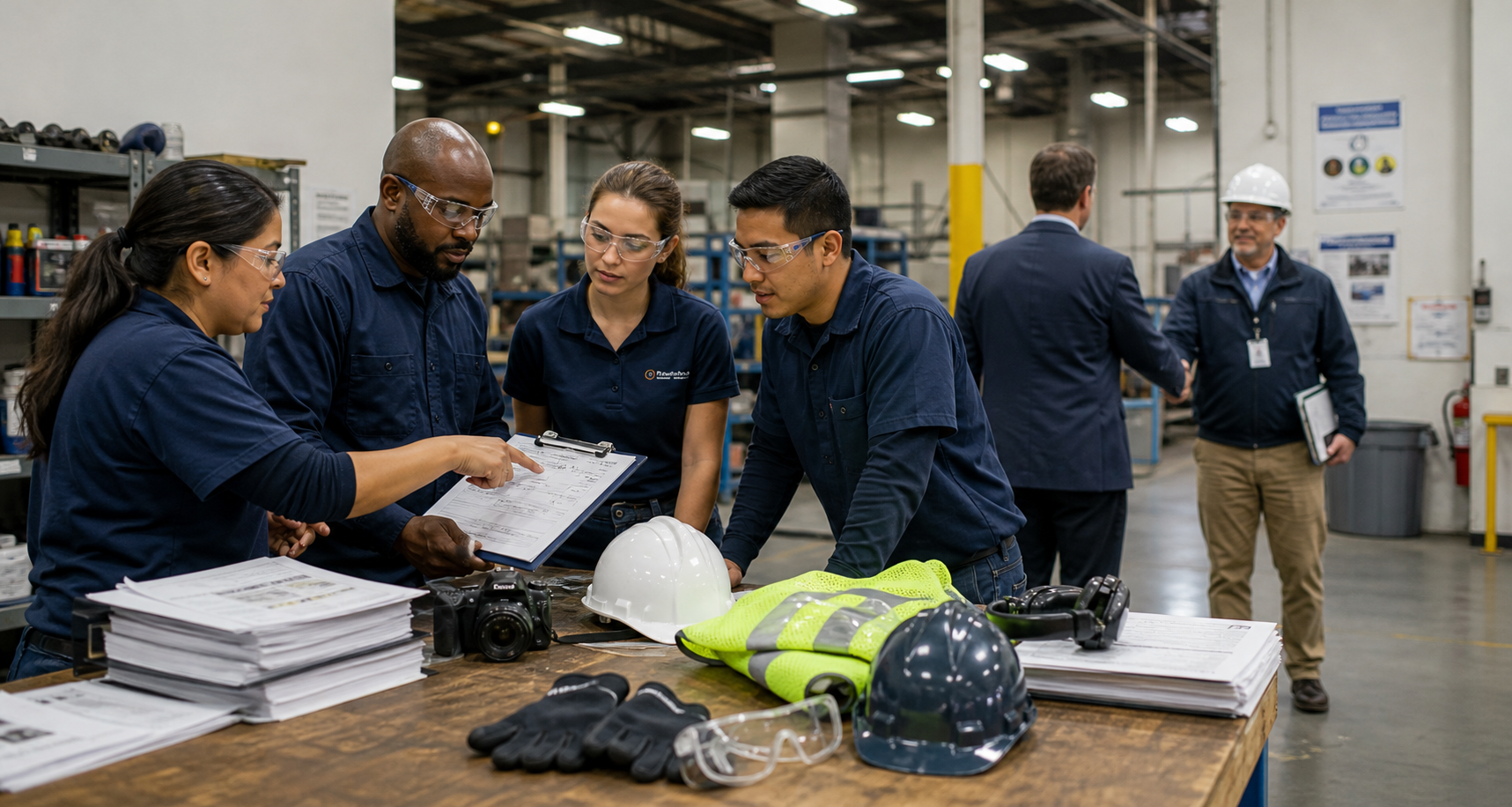
- Assemble an inspection kit. This kit should include:
- A camera for video and photography recording
- Required personal protective equipment (PPE)
- Labels or stamps to mark information that should be tagged as “confidential” or “trade secret”
- Basic facility information (e.g., type of work performed, number of team members, names of leadership personnel and a list of contact information)
- Contact information for the local OSHA office.
- Testing equipment (check calibrations and expirations on equipment regularly)
When the OSHA Compliance Safety and Health Officer Shows Up
- Be polite. Greet the officer and ask to see their credentials if they do not offer to show them. Confirm those credentials or call your local OSHA office for any questions.
- Place the CSHO in the determined private conference room or office.
- Notify the designated company team members who will need to take part in the inspection.
Common Reasons for an OSHA Inspection
- Imminent danger situations
- Fatalities or severe injuries reported to OSHA
- Worker complaints
- Referral inspections (third parties)
- Programmed inspections
During the Opening Conference
- Determine the purpose of the inspection. If there has been a complaint, ask for a copy of the complaint. OSHA will protect the identity of any team member who has submitted a complaint.
- Define the scope of the inspection, and limit consent only to the areas cited in the complaint. This is the time to configure a route for the walk-around, which should be as limited as possible.
- Identify areas of the workplace or documents that might contain trade secrets. Confirm with the CSHO that photographs and/or documents containing information about trade secrets will remain confidential.
- Discuss the process for conducting team member interviews and producing documents. If possible, schedule team member interviews so shifts are covered.
- Ask the CSHO to make all requests for company information and documents in writing. Your company’s legal counsel should review all requests for documents and information, as well as all information and documents provided.
- Gather your inspection equipment.
Safety Documentation to Have
- OSHA 300 Form for the current year and past five years
- OSHA 300A form for the previous five years
- Injury and incident reports for the current year and the past five years
- OSHA 301 Forms (most state workers’ compensation forms are acceptable)
- Completed training programs
- Safety Data Sheets (SDSs)
- Written safety compliance programs
During the Walk-Around
- Begin the walk-around. Make sure everyone has the required PPE and is following the proper safety protocols of the site.
- Keep the route as limited as possible.
- Understand the plain view doctrine. This means a CSHO can investigate any hazard observed while walking through the premises.
- Document the CSHO’s findings and your own findings by taking detailed notes.
- Make sure to take pictures, samples and measurements of anything the CSHO takes, and at the same time. Your company can request that samples and monitoring take place at a time when the company can conduct its own sampling and monitoring.
- Complete “quick fixes” right away. If you or the CSHO identifies any quick fix items, have them taken care of immediately. The CSHO will take these actions as proof of your company’s willingness to comply with safety and health laws.
- Do not interfere with team member interviews. The CSHO has the right to conduct team member interviews in private. Team member interviews may involve labor representatives, rank-and-file team members, and leadership personnel. If there is an interview of a company decision-maker, then it is highly encouraged to have a representative present as any statements made are considered binding admissions on the employer.
Important Reminders for an Inspection
- Document all stages of the inspection. Include the people present, scope of the inspection, areas inspected, and team members interviewed.
- Document the CSHO’s findings and your own.
- If the CSHO deviates from the route for the inspection, document it, inquire about it, and record the reason for the deviation.
- Answer the question asked, and do not provide more information than necessary.
- Never admit a violation took place, that you are at fault or that a citation is appropriate.
During the Closing Conference
- Request copies of all OSHA samples and monitoring reports from the CSHO.
- Ask the CSHO to provide you with an acknowledgment of receipt for all documentation provided during the inspection.
- Provide the CSHO with the name, title and contact information of the person(s) to whom all OSHA correspondence should be directed.
- List out any alleged violations that have already been corrected. If directed by legal counsel, provide additional information and documentation relevant and supportive of the company’s position as well as any information which shows abatement of any alleged violation.
- Do not make any impulsive commitments, for example corrective actions or dates.
- Discuss possible violations. Understand that only the OSHA Area Director can issue citations, and this process can take up to six months after the inspection. The Area Director may rely on a CSHO’s recommendations to issue a citation, but CSHOs may be hesitant to address whether they will recommend a citation during their visit to your facility.
After the Closing Conference
- Try to obtain all sample and monitoring reports from OSHA.
- Provide the company’s legal counsel with copies of all of the documents provided to OSHA and all of the notes, photographs, videos, etc., taken during the inspection. Reference an up-to-date copy of OSHA’s Field Operations Manual. Look this over to determine whether there were any issues during the audit. Any information found can be used as supporting documentation to negotiate a settlement.
Citations
If your facility receives citations from OSHA:
- Post the citation. Post citations in all areas in which the violation occurred. The citations must be posted for three working days or until the violation has been corrected, whichever is later.
- Notify your legal counsel. Immediately notify the company’s legal counsel about the citation and send a copy of the citation to them.
- Start the Abatement Process. Review all areas noted by the CSHO and all violations from previous inspections (if any) and correct any issues that were found within the time frame stated on the citation. Document the corrections to show that abatement was completed. It is important to make sure all hazards are corrected, or you may be assigned larger penalties during subsequent inspections.
- Make note of all deadlines. This avoids creating a short turnaround time to complete abatement measures.
Violation Classification and Penalty Amounts of OSHA Citations
Source document figures — not verified current penalties. The following table reproduces the figures labeled “Maximum Penalty (2026)” in the supplied document. Verify these amounts against current OSHA guidance before publication or reliance. The individual criminal-penalty amount is malformed in the source and has not been guessed.
| Violation |
Description |
Maximum Penalty (2026, as supplied) |
| De Minimis |
Violation based on technical standards, and does not involve any threat to the safety and health of team members. |
Typically, doesn’t carry any penalty. |
| Other Than Serious |
Classified as unlikely to cause serious physical harm or death. |
$14,502 per violation |
| Serious |
Hazards that could cause serious bodily harm or death. |
$14,502 per violation |
| Willful |
The employer committed the violation knowingly or with indifference. |
$145,027 per violation |
| Repeated |
A hazard of a same or similar standard that the employer was aware of before, received a citation for and has not mitigated. |
$145,027 per violation |
| Criminal |
A violation that caused a death and was willful in nature. A violation of this nature is punishable by a misdemeanor conviction and a significant monetary penalty. |
Individual amount unclear in source (“$250,00”); verify before publication. Source states $500,000 for an organization and up to six months in jail. |
Appeals Process
Once you receive a citation, you have a few options for what to do. You can schedule an informal conference with the OSHA Area Director to discuss the violations and try to reach a settlement agreement. If you are unable to reach an agreement, then you can either pay the citation or file a Notice of Contest to pursue a formal hearing.
Informal Conference
You may request an informal conference with the OSHA Area Director to reach a settlement agreement. You are able to discuss citations, penalties, abatement dates or any other information pertinent to the inspection. Though they are informal, be prepared for the conference. Employers can present defenses to citations, and OSHA may agree to withdraw some citations or lower the penalty. Consider the following tips for productive informal conferences:
- Schedule the informal conference promptly. The conference must be held before the end of the 15-day period for filing the Notice to Contest. Please note that there may be some differences in timelines and procedures between federal OSHA offices and agencies run by OSHA-approved state programs.
- Discuss citations and remedial measures taken. If your goal is to have OSHA vacate the citation, be ready to explain why the citation is incorrect or unwarranted.
- Use supporting documents. Even though this is informal, prepare and review your case with your company’s legal counsel. Use an evidence-based approach. Be sure that OSHA has objective evidence regarding each alleged violation. Explain any mitigating circumstances and showcase your company’s commitment to safety.
- Keep track of all issues and their status. You want to make sure every item was resolved.
Remember, OSHA Area Directors want to reach a settlement. Their main goal is to make sure you rectify the identified hazards and are compliant. If you do not reach a settlement agreement, then decide whether to pay the fine or contest it. There may be a reduction in the penalty if the inspection went well; you may have to pay the penalty early in order to pay the discounted amount.
Formal Hearing
If you are contesting the citation, make sure to review timelines and dates for submitting requests and documentation. You must file a Notice of Intent to Contest within 15 working days. By filing a Notice of Contest, the file is transferred over to the Department of Labor to the Office of the Solicitor to begin litigation. A formal hearing will be scheduled and take place in front of an Administrative Law Judge. Formal hearings can be appealed in federal court.
THE HOLT GROUP LLC | Here to Help | www.theholtgroupllc.com
This Holt Group document is not intended to be exhaustive, nor should any discussion or opinions be construed as legal advice. Readers should contact legal counsel for appropriate advice. © Zywave, Inc., The Holt Group LLC All rights reserved. All images are from Google Images and Story Blocks. Revised 2026
.png?width=626&height=160&name=image%20(6).png)